Dissertation Research
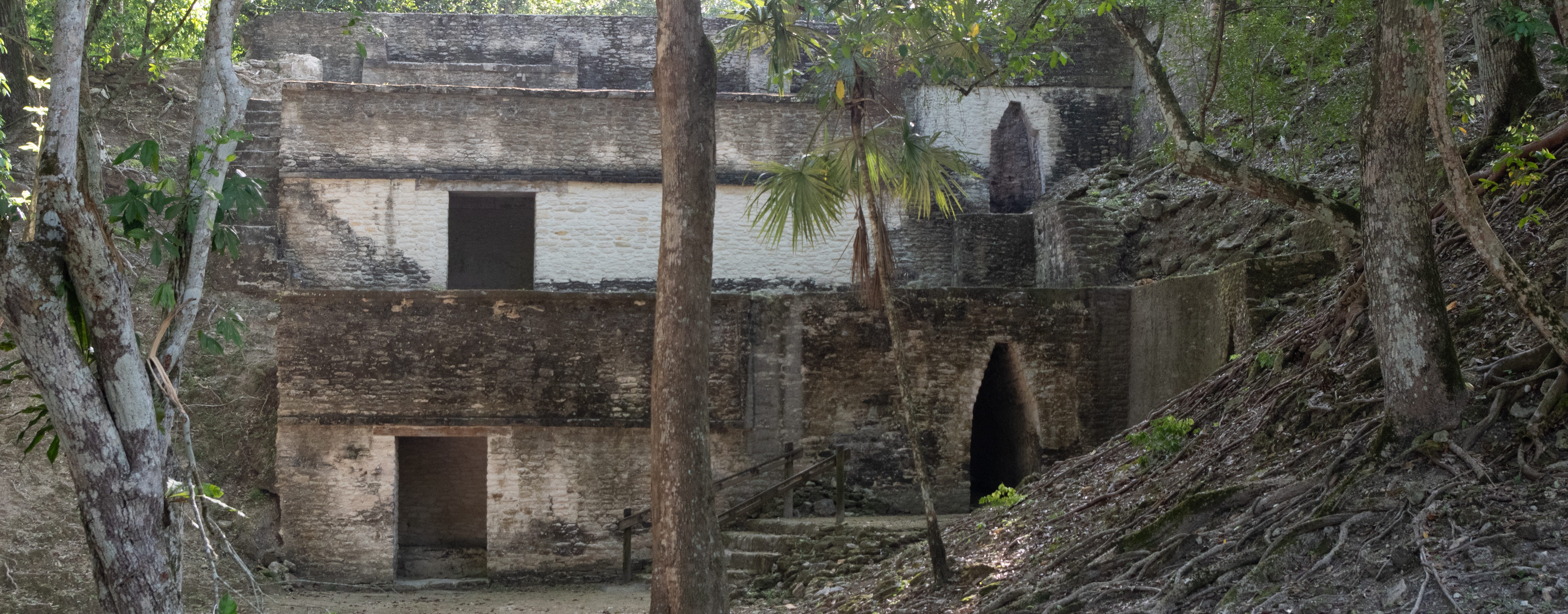
My dissertation research applies interaction models to intermediate elites in the upper Belize River Valley. I tested three alternative hypotheses for site function—ceremonial leader, administrative center, or border manager—using radiocarbon modeling to build a comparative multi-site chronology and ceramic stylistic analysis to assess interaction. The results of excavations at Ek Tzul and eight house mounds in its periphery show that this intermediate site served various dynamic functions. Intermediate elites were situated in a nested hierarchy of interaction spheres with divine kings above them and neighborhoods below. Through same- and cross-scale interactions, each of these spheres developed over time as the power dynamics in the valley changed.
While traditional models suggested these intermediate sites served as frontier posts between larger polities, the growing number of intermediate sites identified by lidar have challenged these models. Function was dependent on spatial and temporal variables with interaction fluctuating as sites were incorporated into larger polities. My future research will develop projects at the neighborhood- and household-level to better understand small-scale institutions in the past.
Zooarchaeology
I am trained in zooarchaeological methods and have applied this training to assemblages from western Wisconsin, southeastern Michigan, Eastern Europe, and Mesoamerica.
My current research focuses on ancient Maya animal use and what it can tell us about past environments. I have examined models of depopulation in the Maya lowlands during the Terminal Classic (AD 750/800-900/1000) using changes in species consumption as a proxy for environmental change. The results indicated no changes in the diversity of animals consumed from the Preclassic (1200 BC-AD 250/300) to the Late/Terminal Classic (AD 600-900/1000).
Fauna is not just indicative of diet but also of the types of ecosystems that were present for the Maya to exploit. My future research will examine species frequencies and their preferred habitats (as quantified by habitat fidelity) to reconstruct the prehistoric mosaic of ecosystems. This is useful in understanding ancient Maya land use and changes in landscape through time. It is also is important for understanding climate change as shifting land use may also lead to less stable systems.
Photogrammetry
Zooarchaeological comparative collections are a necessary resource for conducting faunal analysis of prehistoric and historic sites. The resulting analysis enables archaeologists to reconstruct aspects of past life ways including diet and ritual and political activities. However, comparative collections are expensive to build and maintain. Barriers include access to species from the regions studies, to facilities to process modern specimens into clean bone, and to facilities to curate the comparative specimens. Often, small universities, CRM firms, or other institutions with inadequate space or funding are unable to house their own comparative collection. This leads researchers to have to coordinate with institutions that do have comparative collections, though further barriers hamper these efforts such as access fees and distance from the institution.
Recent advances in photogrammetry and laser scanning enable institutions without the necessary resources to have access to virtual comparative collections. Through the process of photographing or scanning elements from a variety of species, 3D models can be created that can be disseminated digitally. Online repositories of 3D faunal elements enables researchers to access an applicable comparative specimen from anywhere, even in the field. This access results in better identification, the ability to distinguish between human and non-human in the field, and overall better understanding of the past.
Museum of Anthropological Archaeology
3010 School of Education Building
610 E. University Ave.
Ann Arbor, MI 48109
 brett-meyer.com